Today, we possess considerable knowledge about human behavior. Within organizations, approaches dedicated to management, communication, leadership, stress prevention, and quality of work life have proliferated. They provide valuable tools for understanding situations, developing skills, and supporting change. Yet, some difficulties persist. Trained teams continue to encounter the same communication problems. Individuals who are intimately familiar with the mechanisms of stress can find themselves overwhelmed under pressure. Organizations reorganize without always changing the processes that made this reorganization necessary in the first place.
This observation does not mean that existing models are ineffective. It prompts us to ask another question: what makes a known and available resource truly mobilizable when it becomes necessary? There is sometimes a gap between knowing what to do and being able to do it in a real-life situation. This gap can appear within an individual, a relationship, a team, or an entire organization. The challenge then becomes not simply to provide more resources, but to understand what enables—or prevents—their mobilization.
When adding is no longer enough
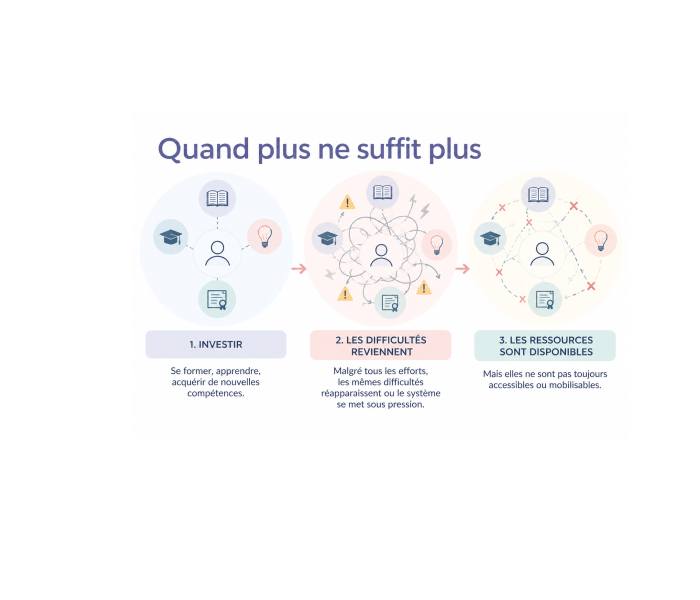
When faced with a persistent difficulty, a common response is to add: more training, procedures, support, control or resources.
These answers may be perfectly relevant. However, when the same difficulties reappear despite the resources invested, continuing to add to them does not necessarily lead to an understanding of what is happening.
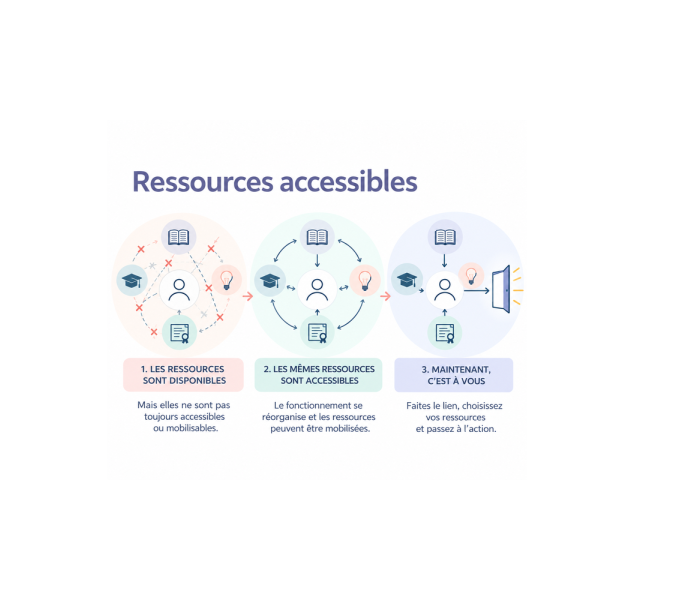
The problem may not be a lack of resources. It may lie in what prevents existing resources from being mobilized.
Before adding a new solution, another question then becomes possible: what is it about the current operation that makes this solution necessary?
Available does not mean mobilizable
A skill can be acquired but not necessarily applicable in all situations. A person may be skilled at communication but lose that ability under pressure. A team may understand the principles of cooperation but revert to defensive behavior when conflict arises.
The resource has not necessarily disappeared. The conditions that allow it to be mobilized have changed.
This distinction profoundly shifts the intervention. Instead of immediately concluding that a skill is lacking, it becomes possible to observe what happens between the available resource and its mobilization in the real situation.
Developing resources remains essential. Understanding the conditions that allow access to them is just as important.
From observation to a new approach
From solution to operation
Existing models provide essential knowledge, skills, and tools. The question is not to replace them, but to understand why their effectiveness varies depending on the people, situations, and times.
When what should work no longer works as expected, the difficulty itself becomes information about how the system is functioning.
Instead of immediately adding a response, it then becomes possible to observe what is happening.
Key points to remember
- Knowing how to do something does not always mean being able to do it.
- A resource that is currently available may become temporarily inaccessible.
- Adding a solution does not necessarily change the mechanism that produces the difficulty.
- The visible manifestation does not always indicate where to intervene.
Before looking for what is missing, observe what prevents what already exists from working.
Observe before interpreting
When a difficulty arises, we naturally try to make sense of it: to identify a cause, make a diagnosis, or decide on a solution. But interpreting too soon can lead us to view the situation through a model before observing what is actually happening.
A model remains a way of looking
A model allows us to organize reality, identify regularities, and guide action. However, it becomes limiting when we try to force observation into the model rather than letting observation question the model.
What doesn't match our expectations isn't necessarily a mistake. It could be information that our current framework doesn't yet allow us to interpret.
It is precisely at this point that the next page begins: Observe before interpreting.