Why this approach?

Why do certain difficulties continue to recur despite all our efforts to change them?

For many years, I sought to understand human behavior through the models presented to me. Like many people, I believed that understanding a difficulty would naturally lead to overcoming it.

Experience has gradually shown me something else. We can understand a mechanism, identify its causes, know what should be done differently… and yet continue to react, decide, or function in the same way. Understanding is valuable. But it is not always enough to make change possible.
This observation led me to explore other approaches, in which the body played a central role. I discovered that transformation can sometimes occur without being preceded by complete intellectual understanding. A new question then arose: why do some changes become permanently integrated while others remain temporary? Why does a resource we know and have already used sometimes become inaccessible precisely when we need it? It is this series of observations that gradually gave rise to this approach.

Before looking for the solution

When faced with a difficulty, the first reflex is often to look for a solution: correct what is not working, modify a behavior or mobilize more resources.

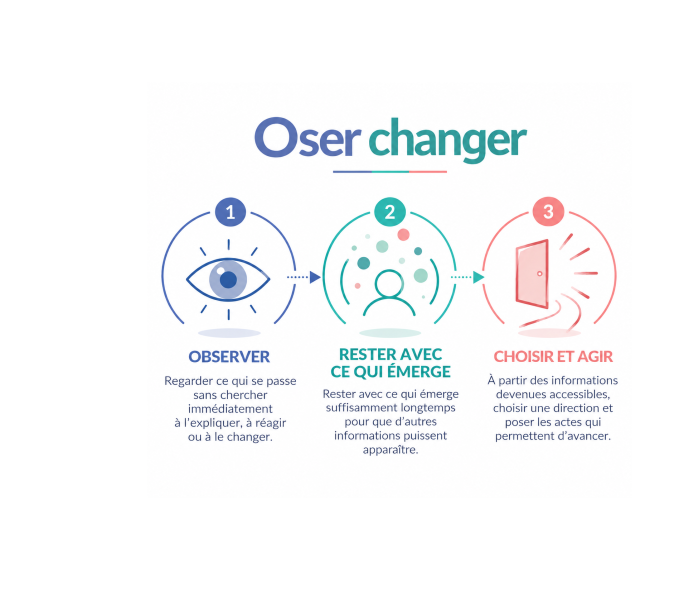
My observation was different: before intervening, it was first necessary to be able to observe precisely what was happening, without immediately seeking to correct it.

This shift allows more information to become visible. As it appears, some possibilities become clearer, others diverge, and a direction can gradually emerge.

Change is no longer a predetermined response. A direction can be considered, but the trajectory is built from the information encountered and how the system responds to it.

P1S1 3 phases

Looking beyond the problem

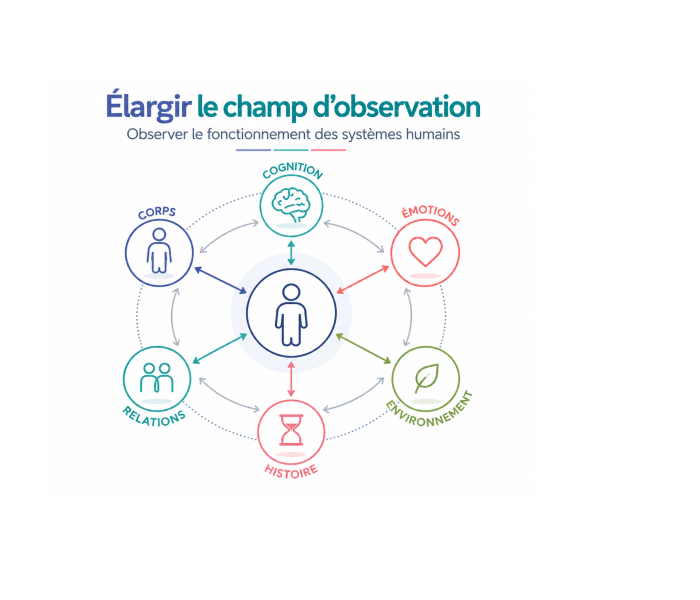
A difficulty never appears in isolation. It is part of a process in which the body, emotions, cognition, relationships, history and environment interact.

Therefore, observing only the visible difficulty does not always allow us to understand what maintains it.

A communication problem, a loss of commitment, a difficulty in making decisions, or a high level of stress can thus be the visible expression of very different ways of functioning.

The field of observation widens: from what poses a problem to the functioning of the system in which the problem appears.

P1S2 widen the field of vision

From observation to a new approach

Another point of observation

This approach does not seek to replace existing models. It proposes to observe what happens between what we know and what we are actually able to mobilize.

Instead of acting solely on the visible difficulty or seeking a new solution, it observes the functioning of the system and the conditions that make certain resources accessible.

This point of observation can be applied to a person, a relationship, a team, or an organization.

Key points to remember


  • Understanding is not always enough to bring about transformation.
  • A resource that is present is not necessarily accessible.
  • An accessible resource is not always usable.
  • The way the system works influences what becomes possible.

Observe not only what should be done, but what makes it possible to do it.

The limitations of current models


Although we have a wealth of knowledge, methods, and tools at our disposal, why do some difficulties persist despite their use?

This question does not necessarily call into question the value of existing models. It invites us to examine what they allow us to observe, but also what may remain outside their field of observation.

The models evolve with our observations

Each era develops models that allow us to understand the world based on the knowledge it possesses.

When an observation no longer fits within the existing framework, two possibilities arise: to consider this observation as an exception, or to accept that it invites us to shift our perspective.

This approach arose from this second choice.

Understanding this shift requires revisiting the models that preceded it, their contributions, but also the questions they still leave open.

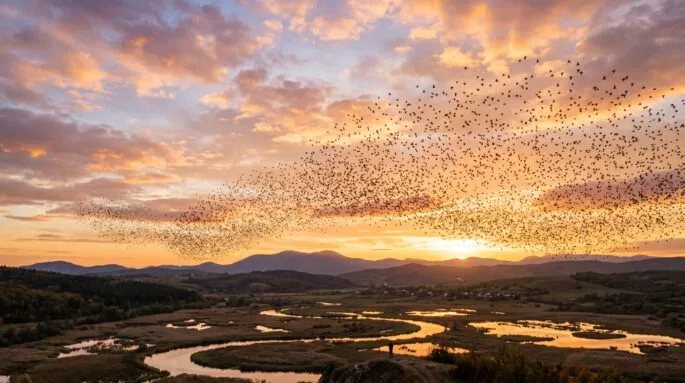
A massive flock of starlings creates a mesmerizing murmuration in the sky during a vibrant sunset over a scenic river valley and rolling mountains