When faced with a difficulty, we naturally seek to understand its meaning. A colleague becomes disengaged: they lack motivation. A team experiences tension: communication is poor. A person is stuck: they resist change. These interpretations may seem obvious. However, when they emerge too early, they immediately influence our investigation, the questions we ask, and the solutions we implement. We then risk intervening based on the explanation we have constructed rather than on what is actually happening.
Observing before interpreting means first reviewing the available information. What is happening? Under what circumstances? What reactions are occurring within the system? What changes depending on the people involved, the time, or the environment? This step requires us not to immediately transform our observations into explanations. Instead, it allows us to keep several possibilities open long enough to gather more information. The more precise the observation, the less we need to fill in the gaps in our knowledge.
We are constantly bombarded by signals
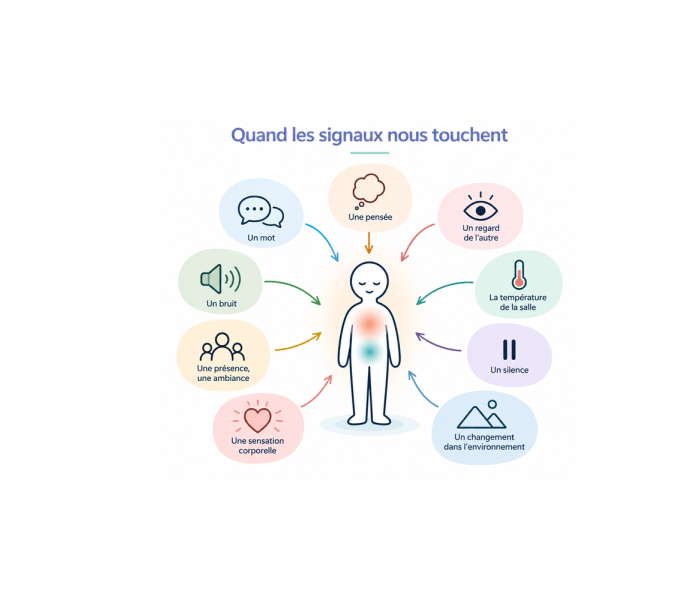
At every moment, the system receives a lot of information. A word, a look, a thought, a bodily sensation, a noise, a temperature, a silence or a change in the environment can all be a signal.
Some go almost unnoticed. Others immediately attract our attention or produce a reaction. This reaction itself becomes new information: the body tenses, an emotion appears, a thought imposes itself, attention shifts, or a response is prepared.
The signal tells us that something is happening. It doesn't yet tell us what it means. Observation consists first of all in distinguishing what reaches us from the response it produces in the system.
When the reaction takes over
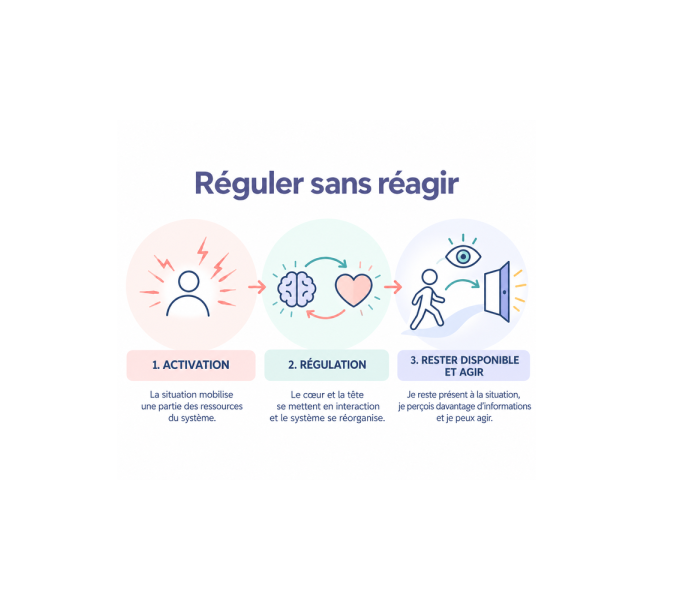
Not all signals affect us in the same way. Some can activate the system enough to alter our attention, our perception, and our response. We then continue to see the situation, but we already see it from the perspective of the state it has created within us.
Regulating allows you to remain present with what is happening without letting this activation alone dictate your response. Heart coherence is one of the tools I use in this context: it acts on physiological regulation while allowing you to remain in the situation and capable of acting. It can therefore be used directly in the field, at the moment the situation arises.
When reactivity decreases, the system mobilizes fewer resources to maintain this physiological response. These resources become available again to perceive what is happening, integrate new information, and act in a more appropriate manner.
Separate observation from interpretation
Observing does not mean being passive
Observing is already an action. It requires directing one's attention, distinguishing what one knows from what one assumes, staying long enough with a situation for other information to emerge, and sometimes regulating one's own reaction to continue observing.
This observation may lead to immediate action. It may also show that it is better not to intervene right away. In both cases, it is not a matter of waiting passively: it is a matter of not deciding on the response before having sufficiently observed the situation.
And action itself can extend observation. We move forward, we see what this action produces, and then this new information can confirm a direction or lead us to change it. Observing and acting are therefore not two opposing moments: they can participate in the same trajectory.
Key points to remember
- A signal indicates that something is happening; it does not necessarily give its meaning.
- The context helps to clarify what is being observed.
- Our own activation can alter what we are able to perceive.
- Regulation can allow other information and response options to become accessible.
Observe. Stay with what appears. Act based on what becomes accessible.
The signal as a starting point
The signal as a starting point
If a signal is neither a problem to be eliminated immediately nor an explanation in itself, it can find another function: to become a starting point for observation.
Rather than immediately asking "what does this mean?", we can follow what it sets in motion: where does it appear, what reactions does it produce, what does it interact with, and how does the system respond? The signal then becomes a gateway to the functioning of the system.
See what's there
Observing does not require understanding everything. It requires accepting that some information is still unknown and not immediately filling that gap with an explanation.
In an environment where we are often expected to make quick decisions, this approach may seem counterintuitive. Yet, delaying a conclusion doesn't prevent action. It allows us to continue acting while letting reality inform us.
What we do not conclude too quickly remains available to be discovered.