What is a living system? A living system is composed of interdependent elements that constantly exchange information, mobilize resources, and adapt to their surroundings. Each element functions independently while also participating in a larger whole. What happens in one part of the system can therefore modify the conditions experienced by other parts and contribute to a reorganization of the entire system. The body is a particularly visible example: its various functions are distinct, but none operates completely in isolation from the others.
Systems thinking shifts the perspective: instead of observing only the elements separately, it also considers the relationships that connect them and how these relationships organize the functioning of the whole. A difficulty that arises in one place does not necessarily find its full explanation there. It can also be the expression of interactions, constraints, or information that circulate—or no longer circulate—throughout the entire system. Understanding a part also requires looking at the whole to which it belongs.
Systems within systems
We belong to several systems simultaneously. An individual has their own way of functioning, participates in a team, and this team is itself part of an organization that has its own history, rules and ways of operating.
These different levels are interdependent. An individual influences the interactions in which they participate, while the team and the organization, in turn, influence their capabilities and responses. And what shapes the system today doesn't necessarily stem solely from the individuals who comprise it today: some information may have been introduced long ago and continue to contribute to its functioning.
The approach therefore focuses on the individual, the team, and the organization in which they are embedded. Depending on what emerges, understanding a situation may require changing the level of observation rather than seeking the entire explanation where the difficulty is most visible.
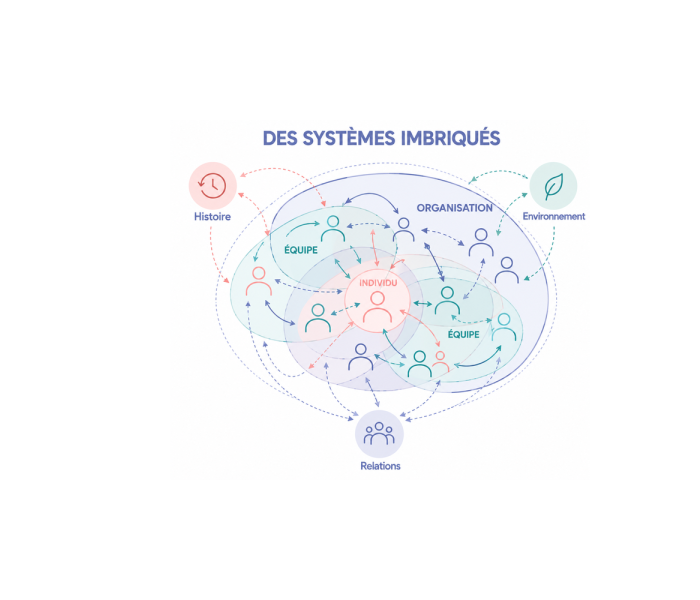
A local modification can extend beyond its starting point
In an interdependent system, when one element changes, it also modifies what the other elements experience. A person who responds differently, information that circulates, or an evolving interaction creates new conditions to which the rest of the system can, in turn, adapt.
But reorganizing sometimes means leaving behind familiar positions, relationships, or responses. Even when they require significant resources, they can be reassuring because they are known and keep everyone in a pattern of functioning that leaves little room for anything else.
This is why the work of a single person can have effects beyond that individual, without all team members having to perform the same task. By changing what they contribute to the system, they open up new possibilities for interaction and reorganization.
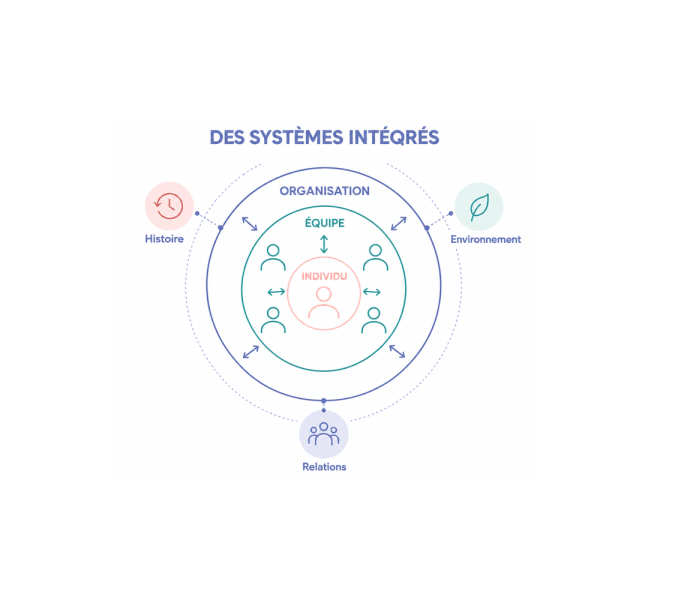
Looking at the systems to which we belong in a different light
A theory derived from practice
In a body as in an organization, what we see does not always explain what is really happening.
A person, a team, or an organization may be aware of the problem, multiply the solutions, and yet reproduce the same patterns of behavior.
It was by observing these discrepancies that a question arose: what is the system actually responding to?
Systems thinking then shifts the focus: rather than looking only for what is problematic, it observes what connects the elements and continues to organize their responses.
Key points to remember
- A system cannot be reduced to the sum of its parts.
- Each element influences the system and in turn experiences the effects of its operation.
- A local modification can change interactions and open the door to a broader reorganization.
- Individuals, teams, and organizations must be able to be observed without being artificially separated.
Changing scale does not mean applying the same response everywhere: it allows us to observe how the same situation is organized at different levels.
From experience to approach
This way of looking at systems was not built solely through study. It arose from a journey between two worlds that were long separated in my professional life: organizations and the functioning of the human body.
→ Discover how the approach came about
Diversity in Unity
A person belongs to the collective but is not reducible to it. A team has its own functioning but does not exist independently of the people who compose it.
The approach therefore considers both simultaneously: the individual within the group and the group in what it makes possible, reinforces or limits in the individual.
Working with one person can change the conditions faced by another. The goal is neither to favor the individual nor the collective, but to allow each person to find their place within a whole that is also capable of transforming itself.
Taking care of the individual without losing sight of the system. Evolving the system without erasing the individual.