A signal mobilizes the system and the resources needed to respond. This activation is normal: it allows us to act, adapt, and cope with what we encounter. When it becomes reactive, the mobilization begins to organize our response beyond what the situation demands. When all our resources can no longer freely serve the same objective, the system redistributes them to continue functioning. We can then continue to act, sometimes very effectively, while dedicating an increasing portion of our resources simply to holding on. Doing more no longer necessarily means making further progress.
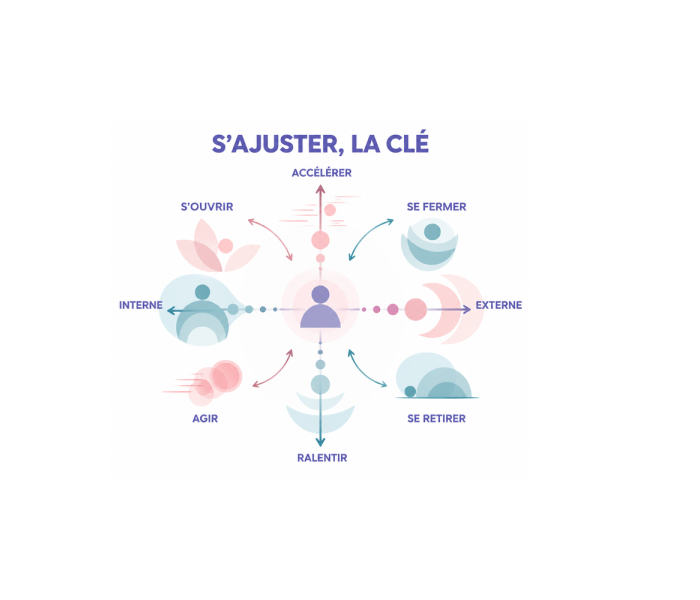
Accelerating or slowing down, opening up or closing down, acting or withdrawing: all these responses can be adapted. The difficulty arises when one way of operating becomes so dominant that others become less accessible. Even a skill can then limit our ability to adapt. We never have all the necessary information before acting. The system fills in what's missing so we can orient ourselves and move forward. Planning is therefore essential. The difficulty arises when what we anticipated can no longer be sufficiently modified by new information.
Why understanding is not always enough
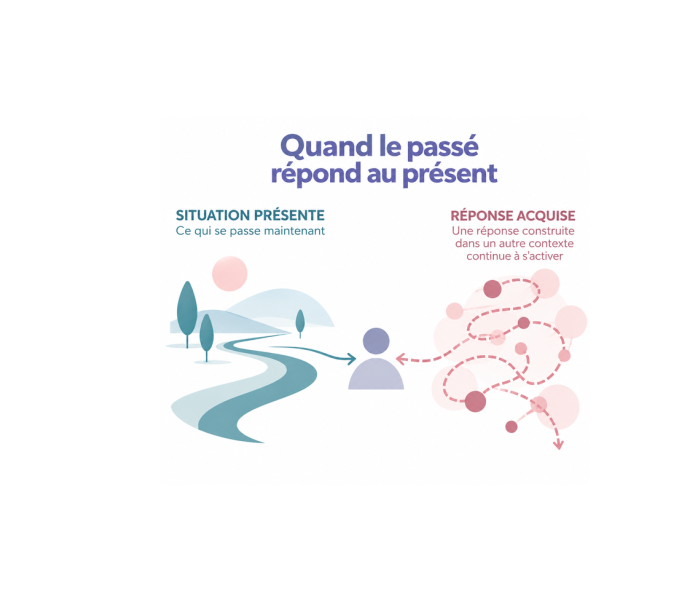
We may know that a situation no longer requires the same response, yet continue to react as before. This discrepancy doesn't necessarily mean we lack understanding or willpower.
A response constructed in a different context can continue to shape our functioning in the present. We receive new information, we may even understand it, but it doesn't yet sufficiently alter our response.
It is this paradox that allows us to understand why we can repeat a behavior whose consequences we know, overreact to a situation, or continue to mobilize a lot of resources without obtaining the desired shift.
The question then changes: what are we really trying to answer?
An appropriate response depends on the context
There is no single right way to operate in every situation. Sometimes we need to speed up and sometimes slow down, to open up or close ourselves off, to act or withdraw, to listen more to what comes from the outside or what is happening inside.
A way of working becomes limiting when it remains dominant while the situation demands something else. It can even become a genuine skill: always being quick, always available, always in action, always attentive to others.
Adapting, therefore, is not about staying in the middle. It's about maintaining enough freedom to change your response when the situation demands it.
Identify what truly shapes our response
To function does not always mean to adjust
Observing is already an action. It requires directing one's attention, distinguishing what one knows from what one assumes, staying long enough with a situation for other information to emerge, and sometimes regulating one's own reaction to continue observing.
We need to anticipate in order to make decisions and move forward. But a projection remains a hypothesis about what might happen. Observe whether new information can still change your interpretation, your decision, or your course when it doesn't correspond to what you had planned.
Key points to remember
- Being active allows you to mobilize the necessary resources.
- Compensation allows us to continue functioning when everything can no longer serve the same purpose.
- Polarizing allows us to favor a response when it has proven particularly useful.
- Projecting allows us to find our way when all the information is not yet available.
These mechanisms become limiting when the system can no longer sufficiently adjust to what it encounters.
What does the system actually address?
We can observe a reaction, recognize a compensation, or identify a response that has become dominant. One question remains: how do we investigate the information that actually contributes to this response?
→ Muscle testing as an investigative tool
Regain some room to maneuver
The goal is not to eliminate the solutions that have allowed us to function. It is to find enough options so that we are no longer dependent on a single way of responding.
When multiple responses become available again, the system can take greater account of what is happening now and mobilize its resources according to the situation rather than according to an organization that has become automatic.
Freedom is not about no longer having a system. It's about being able to change it.